Eyelash extensions are individual synthetic or silk fibers bonded to each of your natural lashes with a cyanoacrylate-based adhesive. Canada currently has no formal regulation around who can apply extensions or what products they use, which means a good chunk of how your set turns out - and how long it lasts - comes down to what you do with it once you leave the chair.
This is the part most people skip past. Here's what to actually do, what to leave alone completely, and which symptoms are worth a second look before your next professional lash appointment.
The Short Version
- Keep lashes completely dry for 24–48 hours after application, so the adhesive can fully cure.
- Skip oil-based skincare, makeup removers, and waterproof mascara for the entire life of the set.
- Sleep on your back or side - never face-down into a pillow.
- Brush lashes each morning with a clean, dry spoolie.
- Book a fill every 2–3 weeks, before natural shedding gets ahead of the fit.
The First 24 to 48 Hours: Let the Bond Cure
The adhesive needs uninterrupted time to set. Moisture, steam, and friction during this window are the single biggest reason people lose extensions in the first few days — before the bond has even had a chance to do its job.
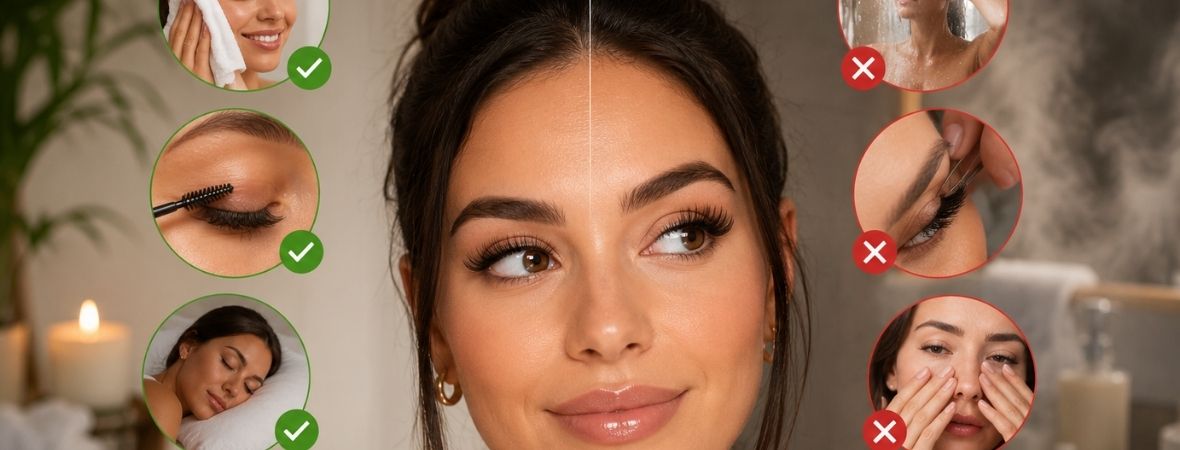
- Let the adhesive set completely undisturbed
- Step into fresh air if your eyes feel warm
- Shower, cry, or let steam near your face
- Rub or apply pressure to your eyes
- Wash your face everywhere except the lash line
- Pat gently if product runs close to the eyes
- Swim, sauna, or take a hot yoga class
- Wear mascara or eyeliner near the base
- Start a gentle, oil-free lash cleanser routine
- Brush lashes each morning with a clean spoolie
- Use a lash curler - extensions hold curl already
- Book a facial without mentioning your lashes first
- Cleanse daily to stop buildup along the lash line
- Book a fill every 2–3 weeks
- Pick or pull at loose extensions
- Skip fills and expect the set to hold past week 4
Daily cleansing matters more than most people expect: leftover oil, makeup, and skin cells along the lash line are a known cause of blepharitis, a common eyelid inflammation, and they also weaken the bond faster.
Fill Countdown Calculator
Enter your application date and lash style to see roughly when to book your next fill.
What to Avoid Completely

A few habits do more damage to a lash set than anything else, and most of them are things people don't realize are the problem until the set is already thinning out. Some of these overlap with a few common skincare habits worth rethinking in general, not just around lash extensions.
- Oil-based cleansers or makeup removers near the lash line
- Waterproof mascara
- Eyelash curlers or at-home lash perming kits
- Steam facials, saunas, or hot showers aimed at the face
- Sleeping face-down, or rubbing itchy eyes
- An oil-free, lash-safe foam cleanser
- A water-based mascara on the tips only, if needed
- A clean, dry spoolie to reshape lashes each morning
- Face-up rest and cooler showers, especially in week one
- Letting loose extensions shed on their own
Daily maintenance doesn't need to compete with the rest of your routine. A hydrating facial or a brow shaping visit can both be booked alongside a lash appointment - just let your esthetician know you have extensions so they can work around the eye area.
Is It Lash-Safe?
Pick a product or activity to see how it plays with a fresh set of extensions.
When It's More Than Irritation
A little warmth or watering right after application is normal - it usually settles within a day as the adhesive finishes curing. The signs below are different, and worth paying attention to.
Mild Irritation
Slight redness, a subtle itch, or watery eyes from adhesive fumes. This typically fades on its own within a day or two.
Allergic Reaction
Swelling, intense itching, or redness that shows up anywhere from a few minutes to about 48 hours after application and doesn't improve on its own. According to the American Academy of Ophthalmology, this is often linked to ingredients in the adhesive itself, and it can temporarily affect vision if it's severe enough.
Infection
Discharge, crusting, ongoing pain, or a lash that feels trapped under the eyelid are not something to wait out. The Canadian Association of Optometrists notes that damage to the eyelid or cornea during application can allow infection to take hold, which in rare cases can scar the eye or affect vision - so these symptoms are worth a same-week visit to an optometrist.
A Note on Long-Term Wear
Research presented at the 2026 American Society of Cataract and Refractive Surgery meeting found a strong association between long-term lash procedure use and dry eye symptoms, though the study was small and the link is still being studied.
It's one more reason technicians generally recommend the occasional break between lash cycles, rather than back-to-back sets with no rest for your natural lashes.
Frequently Asked Questions
Most technicians recommend keeping the lash line completely dry for 24 to 48 hours after application, to give the adhesive time to fully cure. Ask yours for the exact window, since it depends on the glue they use.
It's usually oil-based products, friction from rubbing or sleeping face-down, or buildup from skipping daily cleansing. Here's a closer look at premature shedding and how to get ahead of it.
It's best to skip it, especially waterproof formulas, since removing them needs an oil-based remover that breaks down the bond. If you want a bit more, a water-based formula on the tips only is the safer route.
It depends on what you're after. Take a look at how a lash lift compares to extensions before deciding which fits your routine better.
Every 2 to 3 weeks for most people. Extensions are bonded to natural lashes, and those lashes shed on their own cycle, so gaps show up as they fall out.
Possibly, but a patch test first is strongly recommended. Lash adhesives are cyanoacrylate-based and may contain trace ingredients, including formaldehyde, that can trigger a reaction in some people.
Ready for Your Next Set?
Bring any questions about your last fill with you - our team will walk you through exactly what your lashes need.
Get in Touch With Our TeamSources
- Canadian Association of Optometrists — Eyelash Extensions
- American Academy of Ophthalmology — Eyelash Extension Facts and Safety
- Medscape — Cosmetic Eyelash Extensions Independently Associated With Dry Eye Symptoms, ASCRS 2026 Annual Meeting
This article is for general information only and isn't a substitute for professional medical advice. If you notice signs of infection or a severe allergic reaction, contact a healthcare provider or optometrist promptly.