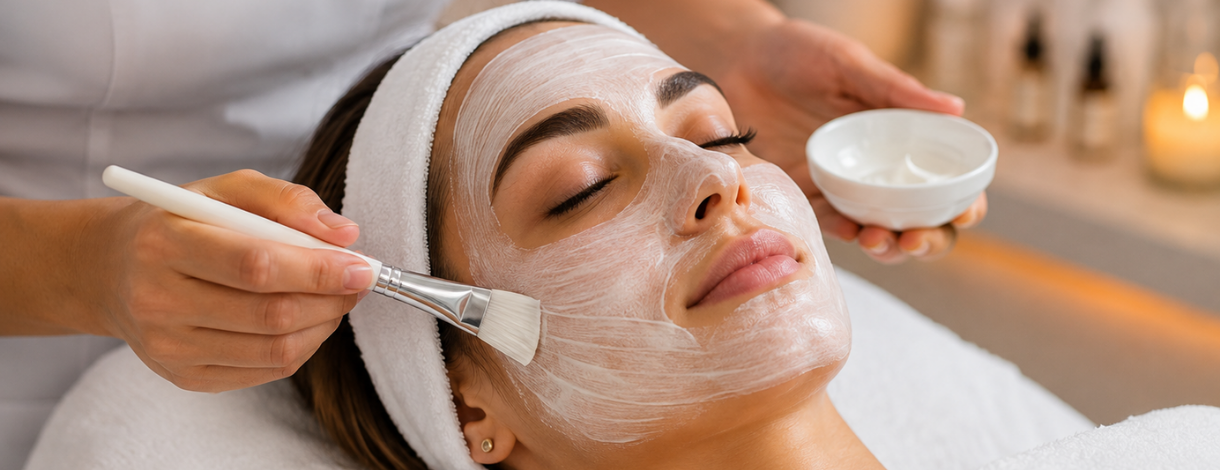
There is a simple answer to this question, but it is not always “once a month.” For many people, a professional facial every 4 to 8 weeks is a sensible maintenance range. But that number changes when you switch from a maintenance facial to a treatment designed to correct a specific concern.
A HydraFacial, dermaplaning treatment, customized facial, chemical peel and microneedling session do very different jobs. Your skin also changes with the season, your home-care routine, stress, sun exposure and whatever else is going on in your life. That is why a good facial plan is based on what your skin needs now, not a calendar rule.
The Short Answer
For general skin maintenance, every 4–8 weeks is a reasonable starting point for many people. HydraFacial is often done monthly, while stronger resurfacing treatments such as peels or microneedling usually need more deliberate spacing. Some people need treatment less often; others benefit from a short series.
The key is this: frequency should follow the treatment and the goal, not the other way around.
How Often Should You Actually Book One?
Think of professional facials in four broad categories. Once you know which category your treatment belongs to, the schedule starts to make much more sense.
Usually every 4–8 weeks. This is where regular customized facials and similar lower-intensity treatments fit.
Often monthly, especially if your goal is consistently smoother, cleaner and more hydrated-looking skin.
Peels and microneedling are often planned as a series, with recovery time built between appointments.
A one-off treatment can make sense when you want a polished, fresh look before a wedding, vacation, photo shoot or event.
The Schedule Depends on What Treatment You're Getting
“A facial” is a very broad term. A treatment focused mainly on hydration and surface cleansing is not the same thing as a procedure designed to stimulate collagen.
| Treatment | Typical spacing | Best thought of as | Why the spacing matters |
|---|---|---|---|
| Customized Facial | About every 4–8 weeks | Maintenance + targeted skin support | The treatment can be adjusted to your current skin instead of repeating the exact same protocol every time. |
| HydraFacial | Often monthly; sometimes every 2–3 months | Hydration, congestion and regular upkeep | It is relatively gentle, but the right schedule still depends on your skin goals and other exfoliating treatments. |
| Dermaplaning | Usually spaced several weeks apart | Surface smoothing + removal of peach fuzz | Skin still needs time between exfoliating treatments, particularly if you use acids or retinoids at home. |
| Superficial Chemical Peel | Often a planned series with several weeks between treatments | Resurfacing + tone/texture work | Peel strength, skin sensitivity and the desired outcome determine how quickly another treatment should be done. |
| Microneedling | Usually farther apart than a standard facial | Collagen and texture improvement | Your skin needs recovery time, and collagen remodelling continues after the appointment. |
These are practical planning ranges, not prescriptions. Treatment depth, skin condition, products used at home, medical history and the protocol being performed can all change the appropriate interval.
Why “Every 4 Weeks” Is Not a Rule
You will often hear the advice to get a facial every four weeks because that is an easy schedule to remember. It is also close enough to a typical monthly maintenance routine for many clients.
But skin does not run on a four-week appointment cycle.
If your skin is dry and reactive, more frequent exfoliation may leave you feeling worse, not better. If you are dealing with congestion, you may benefit from more structured professional maintenance. If you are doing microneedling, repeating the appointment simply because four weeks have passed may not make sense.
The treatment has to earn its place on the calendar.
More Treatment Does Not Automatically Mean Better Skin
One of the most common mistakes is treating visible skin problems by adding more and more exfoliation. Dermatologists specifically caution that over-exfoliation can leave skin red, irritated and more reactive. The more aggressive the exfoliation, the less often it generally needs to be performed. The American Academy of Dermatology explains the same principle here.
Find Your Facial Frequency: A 60-Second Quiz
This is not a diagnosis. It is a practical way to think about your next appointment based on what you are actually trying to improve.
What Kind of Facial Schedule Fits You?
Choose the answer that sounds most like your skin right now.
Match the Frequency to Your Skin Goal
The same treatment can have a different schedule depending on why you are doing it. Here is the practical way I would think about it.
“I just want my skin to look better consistently.”
This is classic maintenance territory. A customized facial every 4–8 weeks can work well, especially when your home routine is doing the daily work between visits.
The goal is not to keep “resetting” the skin. It is to make small, useful adjustments as your skin changes.
“My skin looks dull and I want that fresh glow back.”
HydraFacial or dermaplaning can be useful when the problem is mostly surface-level buildup, dehydration or a lack of smoothness.
These are also common choices when you want visible improvement without planning your life around downtime.
“My pores look clogged and my skin feels congested.”
Regular professional cleansing and extraction-based treatments may make more sense than simply adding stronger exfoliating products at home.
The exact frequency depends on how quickly congestion returns and what is causing it in the first place.
“I want to change texture, fine lines or acne marks.”
This is where treatment frequency usually becomes more strategic. Microneedling and peels are generally approached as a series rather than an endless monthly facial.
Results build over time, so spacing matters just as much as the treatment itself.
HydraFacial: Is Monthly Really Necessary?
Not necessarily.
Monthly HydraFacial is a common maintenance schedule because the treatment is relatively gentle and combines cleansing, exfoliation, extraction and hydration. The manufacturer notes that some clients schedule about once a month, while others may prefer every 2–3 months depending on their skin and goals. HydraFacial's own FAQ explains the range here.
At Deco De Mode Toronto, HydraFacial can be used as a regular maintenance treatment, but the point is not to put every client on an identical calendar. Your skin may need more attention before an event and much less once things are stable.
Our HydraFacial treatments in Yorkville are also customizable depending on whether the priority is hydration, congestion, brightness or overall skin refresh.
What About Dermaplaning?
Dermaplaning is different from a general facial because it intentionally removes surface dead skin cells and fine vellus hair. The immediate effect can be very satisfying: smoother skin, more even makeup application and a brighter-looking surface.
But that does not mean it should become your weekly exfoliation method.
The interval needs to take into account the rest of your routine. If you are already using acids, retinoids or other exfoliating products, stacking too much exfoliation can leave the skin irritated. The American Academy of Dermatology recommends adjusting exfoliation to your skin type and avoiding over-exfoliation. See the AAD's exfoliation guidance.
Learn more about how we approach professional dermaplaning in Toronto when a smoother surface is the goal.
How Often Should You Get a Chemical Peel?
This is where the word “facial” becomes misleading. A superficial peel can be part of a planned series, while a stronger peel may require much more recovery.
The American Academy of Dermatology notes that some refreshing or lunchtime peels may be repeated every 2 to 5 weeks as part of a treatment plan, while stronger peels have substantially longer healing periods. The correct interval depends on the strength and type of peel, the condition of the skin and the professional performing it. The AAD's chemical peel guide explains the differences here.
That is why “How often can I get a peel?” cannot really be answered without first asking, “Which peel?”
At Deco De Mode, our Fire & Ice Peel is positioned as a resurfacing treatment for concerns such as dullness, uneven texture and congested-looking skin, rather than something that should simply be repeated on autopilot.
Microneedling Is Different Again
Microneedling should not be treated like a regular facial appointment.
The reason is simple: the treatment intentionally stimulates the skin's repair process. The visible result develops gradually as collagen is produced and remodelled. The American Academy of Dermatology notes that some people need multiple treatments and that results can continue developing over several months. See the AAD's microneedling guidance.
In other words, booking another session simply because your calendar says “four weeks” does not automatically mean you are ready. Your provider should be looking at how your skin responded to the previous session and what the overall treatment plan is trying to accomplish.
For more on the treatment itself, see our microneedling treatment guide.
Toronto Changes the Conversation a Little
If you live in Toronto, your skin deals with some very different environments over the course of a year. Cold outdoor air, dry heated indoor spaces, summer humidity, stronger sun exposure and daily city life can all change how your skin behaves.
Think barrier first
Cold air and indoor heating can leave skin feeling tighter and drier. This is not always the moment to aggressively exfoliate.
Reassess
If winter left you dull or rough, spring can be a good time to reassess your routine rather than simply adding stronger products.
Watch the sun
Outdoor exposure, heat and sweat can change congestion and pigmentation concerns. Sun protection matters especially when resurfacing.
Plan corrective work
Many people use fall as a convenient time to build a structured treatment plan after summer sun exposure and before winter dryness returns.
This does not mean every Toronto resident needs a completely different facial every season. It means your treatment plan should be flexible enough to respond when your skin changes.
How Often Should You Get a Facial in Your 20s, 30s, 40s and Beyond?
Age matters less than your actual skin concerns, but there are a few patterns worth knowing.
20s: Maintenance Usually Wins
If your skin is healthy, you generally do not need an aggressive treatment schedule simply because you are in your twenties. Congestion, acne, dehydration or pigmentation may be better reasons to book than age itself.
30s: Prevention and Consistency Matter More
This is often where people start noticing that their skin does not “bounce back” quite as quickly from stress, dehydration and inconsistent skincare. A sensible maintenance routine plus targeted treatments can be more useful than constantly changing products.
40s and Beyond: Match the Treatment to the Change You Want
If your goal shifts toward fine lines, texture, pigmentation or loss of firmness, the treatment plan may move beyond simple monthly facials. This is where peels, microneedling and other targeted approaches can have a more strategic role.
None of these age groups has a magic number. Your skin concern is more useful than your birthday when deciding frequency.
When You Should Skip the Appointment
One of the signs of an experienced skin professional is knowing when not to treat.
- × Your skin is actively irritated, peeling or unusually sensitive.
- × You have a recent sunburn or significant sun exposure.
- × You are stacking several strong exfoliating products at home.
- × You are still recovering from a more intensive procedure.
- × You are booking only because “it's been four weeks.”
- ✓ Let the skin barrier settle before adding another active treatment.
- ✓ Tell your esthetician about recent treatments and current products.
- ✓ Build recovery time into peel and microneedling plans.
- ✓ Use sunscreen consistently, especially after resurfacing treatments.
- ✓ Choose the next appointment based on the skin in front of you.
What About Facials Before a Big Event?
This is one situation where your usual maintenance schedule can go out the window.
If you have a wedding, vacation, birthday, photo shoot or another event coming up, the question changes from “How often should I get facials?” to “Which treatment gives me the result I want without creating unnecessary risk right before the event?”
That usually means avoiding the temptation to try the strongest treatment you have never had before at the last minute. A gentle, familiar treatment with little downtime can make much more sense.
For example, HydraFacial can be a practical event-prep choice when your priority is immediate hydration and a fresh-looking surface, while microneedling or a peel is better planned with more lead time.
How to Know You Are Getting the Frequency Right
You are probably on a sensible schedule when your skin looks and feels progressively more stable between appointments, rather than temporarily improving and then becoming increasingly irritated.
A good plan should also be sustainable. You should know what each appointment is meant to accomplish, what you are doing at home between visits, and when you should change course.
If you are constantly adding another treatment because you do not see enough change, that is usually a sign to stop and reassess the plan, not necessarily book more often.
A Better Way to Think About Facial Frequency
Maintenance: keep skin consistent.
Corrective treatment: work toward a specific change.
Event treatment: prioritize predictable results and minimal downtime.
Recovery: give the skin enough time to respond before repeating a stronger procedure.
Frequently Asked Questions
For general maintenance, many people do well with a professional facial about every 4 to 8 weeks. The right interval depends on the treatment, your concerns, your home routine and how your skin responds.
Yes. Monthly HydraFacial treatments are a common maintenance schedule, but some people may prefer every two to three months. The treatment should still be adjusted to your skin goals.
Microneedling usually needs more deliberate spacing than a regular facial because the skin needs recovery time and collagen remodelling continues after the appointment. Your provider should determine the interval based on your concern and protocol.
Dermaplaning is normally spaced out rather than used as frequent exfoliation. The right interval depends on your skin, home-care products and whether you combine it with other exfoliating treatments.
There is no single answer because peel strength matters. Superficial peels may be repeated as part of a series, while stronger peels require much more recovery. Your treating professional should set the interval.
Yes. Repeated exfoliation or procedures without enough recovery can contribute to dryness, redness and irritation. More treatment is not automatically better.
Not Sure What Your Skin Needs Next?
We can look at what your skin is doing now, what you have been using at home and what you are hoping to change, then help you choose a treatment schedule that makes sense.
Talk to Our Toronto TeamSources
- American Academy of Dermatology — How to safely exfoliate at home
- American Academy of Dermatology — Chemical peels: FAQs
- American Academy of Dermatology — Microneedling: What to expect
- HydraFacial — Frequently Asked Questions
This article is for general skin-care information and is not a substitute for medical advice. Treatment frequency should be individualized, particularly when you have a skin condition, are using prescription products or are combining professional treatments.